
Choosing between satellite internet and a 5G home router usually comes down to one question: which connection works better where you live?
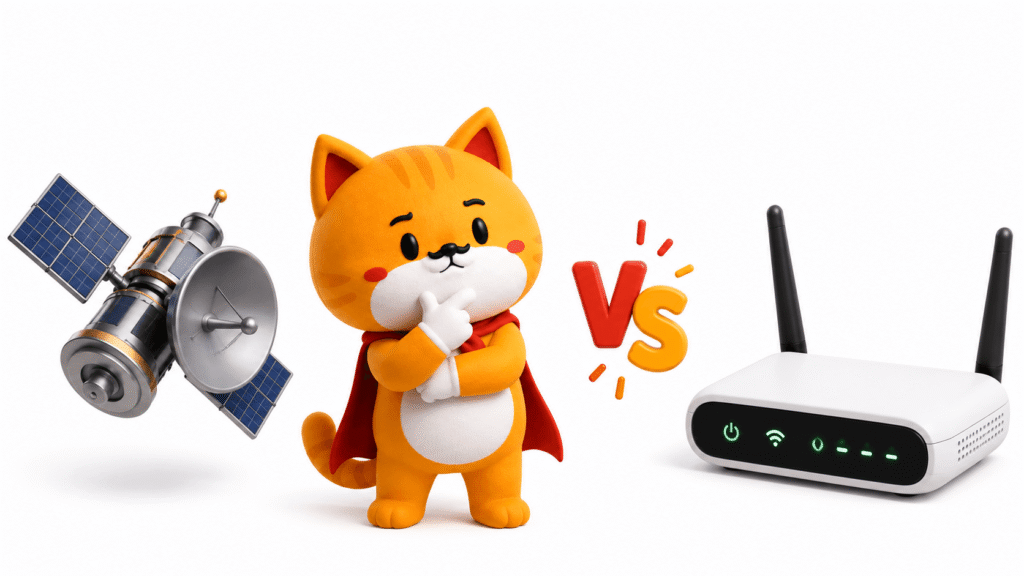
Both options can provide internet without a traditional fiber or cable line, but they work in very different ways. Satellite internet connects through a dish and satellites in orbit, while a 5G home router uses nearby mobile towers.
Neither is automatically better for everyone.
How Satellite Internet Works
Satellite internet sends data between your home, a satellite and a ground station.
You normally need:
- A satellite dish
- A modem or router
- A clear view of the sky
- A monthly service plan
Its biggest advantage is coverage. Satellite internet can reach rural and isolated locations where mobile networks or wired connections are unavailable.
How a 5G Home Router Works
A 5G home router connects to the same type of cellular network used by smartphones.
Instead of installing a cable line, you place the router inside your home and connect your devices through Wi-Fi. Some services use a SIM card, while others provide a dedicated router linked to a fixed wireless plan.
Its performance depends heavily on:
- Distance from the nearest tower
- Signal strength
- Building materials
- Network congestion
- Local 5G availability
Satellite Internet Advantages
Satellite internet can be a strong option when coverage is the main concern.
Its main advantages include:
- Availability in remote locations
- No need for nearby fiber or cable infrastructure
- Useful for farms, cabins and isolated homes
- Wider geographic coverage
- A practical backup connection in some areas
For people who live far from cities, satellite internet may be one of the few realistic broadband options.
Satellite Internet Disadvantages
Satellite service also has some important limitations.
Possible disadvantages include:
- Higher equipment and installation costs
- The need for a clear view of the sky
- Signal interruptions caused by obstacles
- Performance changes during severe weather
- Higher latency than many land-based connections
- Limited portability once the equipment is installed
Latency is especially important for activities that require quick responses, such as competitive gaming or some real-time work applications.
5G Home Router Advantages
A 5G home router is usually easier to install and may provide better responsiveness when the signal is strong.
Its advantages can include:
- Simple setup
- Lower latency
- Fast download speeds in well-covered areas
- Easy connection for phones, laptops and smart devices
- Greater portability than a satellite dish
- No need to install a permanent cable line
For many users, setup may be as simple as placing the router near a window and connecting to Wi-Fi.
5G Home Router Disadvantages
The main weakness of 5G home internet is that performance depends on the mobile network.
Possible problems include:
- Weak or unavailable signal in rural areas
- Speed reductions during busy hours
- Poor indoor reception
- Inconsistent performance between rooms
- Data limits or traffic management
- Dependence on nearby mobile towers
A plan may advertise high speeds, but real-world performance can be much lower when the signal is weak or the network is congested.
Which One Is Faster?
A strong 5G connection will often feel faster and more responsive than satellite internet.
However, speed is not guaranteed. A 5G router located far from a tower may perform worse than a stable satellite connection.
Satellite internet may offer more predictable availability in remote areas, while 5G can deliver better performance in towns, suburbs and locations with strong network coverage.
The best way to compare them is to check actual service availability at your address rather than relying only on advertised speeds.
Which Is Better for Gaming?
A 5G home router is generally the better option for online gaming when it has a strong and stable signal.
Lower latency can improve:
- Response times
- Competitive matches
- Voice chat
- Cloud gaming
- Game downloads
Satellite internet can still work for casual gaming and downloads, but latency may make fast competitive games less comfortable.
Which Is Better for Streaming?
Both options may support video streaming, but the result depends on speed, stability and data policies.
Satellite internet can be suitable for streaming when the signal is clear and the plan offers enough data.
A 5G router may provide smoother high-resolution streaming in areas with good coverage, but performance can fall during periods of network congestion.
Households with several people streaming at the same time should pay close attention to data limits and typical evening speeds.
Which Is Better for Remote Work?
A 5G home router may be better for video calls and interactive work because of its lower latency.
Satellite internet may be more valuable when the alternative is having no reliable connection at all.
Remote workers should consider:
- Video-call stability
- Upload speed
- Data limits
- Network outages
- Backup options
- VPN compatibility
The fastest advertised plan is not always the most reliable choice.
Installation and Portability
A 5G router is usually easier to move and install. It may work in different locations as long as the service agreement allows it and coverage is available.
Satellite internet normally requires more planning. The dish must be installed where it has a clear view of the sky, and trees, buildings or mountains can interfere with the signal.
This makes 5G more convenient for renters and frequent movers, while satellite may be better suited to permanent rural properties.
Which One Should You Choose?
Choose satellite internet when:
- You live in a very remote area
- Mobile coverage is weak or unavailable
- Wired broadband does not reach your property
- Availability matters more than low latency
Choose a 5G home router when:
- Your home has strong 5G coverage
- You want simple installation
- You play online games
- You frequently use video calls
- You need a more portable connection
Final Verdict
Satellite internet is not always better than a 5G home router, but it can be the better solution in places where cellular coverage is unreliable or nonexistent.
A 5G home router will usually be more attractive when strong mobile coverage is available because it offers easier installation, lower latency and potentially faster performance.
Before choosing, check coverage at your exact address, compare data limits and review the total cost of equipment and monthly service.